Public Notices & News
Caladh Avenue Construction Project - Updates
- Details
- Published: Tuesday, 09 September 2025 14:34
Caladh Avenue and the surrounding area will undergo extensive reconstruction this fall 2025 to elevate the road network and strengthen coastal defenses. This work covers a stretch of the waterfront from behind the former Consulate Inn on the Jitney Trail to Coleraine Street. Key upgrades include raising the street level by two meters between Commercial Street and Market Street, installing new sidewalks, asphalt resurfacing, and adding a multi-use pathway that includes a bike lane on the south side of the street. Once complete, the updated roadway will connect seamlessly to existing roads and trails.
The street will then become one way, west bound, creating a downtown loop. These improvements are critical for safeguarding both private and public properties along a vulnerable waterfront floodplain, especially as the region faces increasingly severe weather events that threaten infrastructure and strain water management systems.
Questions & Answers
Q: When will construction begin?
A: Work will begin after Labour Day, starting with underground work.
Q: Which area will be affected by the construction?
A: The work will take place on Caladh Avenue between Market Street and Coleraine Street.
Q: What will the construction include?
A: Key upgrades include raising the street level to two meters above sea level between Coleraine Street and Market Street; replacing underground services, installing new sidewalks, lighting, boardwalk, asphalt resurfacing, and adding a new multi-use pathway that includes a bike lane on the south side of the street. Once completed this section of the street will become one way.
Q: How will the construction progress?
October: Work will begin on the north side of the street, followed by the south side. November/December: Paving is scheduled to begin in late November and continue into early December.
Q: Will Caladh Avenue remain open to traffic?
A: Yes. The street will remain open to one-way traffic throughout the construction period.
Q: Will businesses remain accessible?
A: Yes. All businesses can be accessed by foot traffic during the project.
Q: Will there be water outages?
A: Yes. Planned water outages will occur during main connection periods, with public notice provided in advance. However, due to the age of the system, unforeseen outages may also occur.
Q: What happens to on-street parking during construction?
A: There will be no on-street parking on Caladh Avenue. Alternate parking is available at: Public parking lots (access from Water Street only), New Horizons (after events), deCoste Centre (east & west sides), Justice Complex (after
daytime hours), Vendor Village (27 Creighton St.), and CN Station.
Q: How will tour bus parking be managed?
A: Tour buses will be accommodated, with designated parking arranged according to known schedules.
Q: Will delivery trucks be able to access my business/organization?
A: Access may be challenging at times; however, the Town and its contractors will coordinate with you to ensure deliveries can be accommodated.
Q: Who do I contact if I have a question?
A: Contact the Town of Pictou Administration Office at 902-485-4372.
Q: Where can I found out more about this project?
A: Visit the Town website at https://www.townofpictou.ca/current-projects
Off Highway Vehicle - Street Map & General Information
- Details
- Published: Thursday, 31 July 2025 10:16
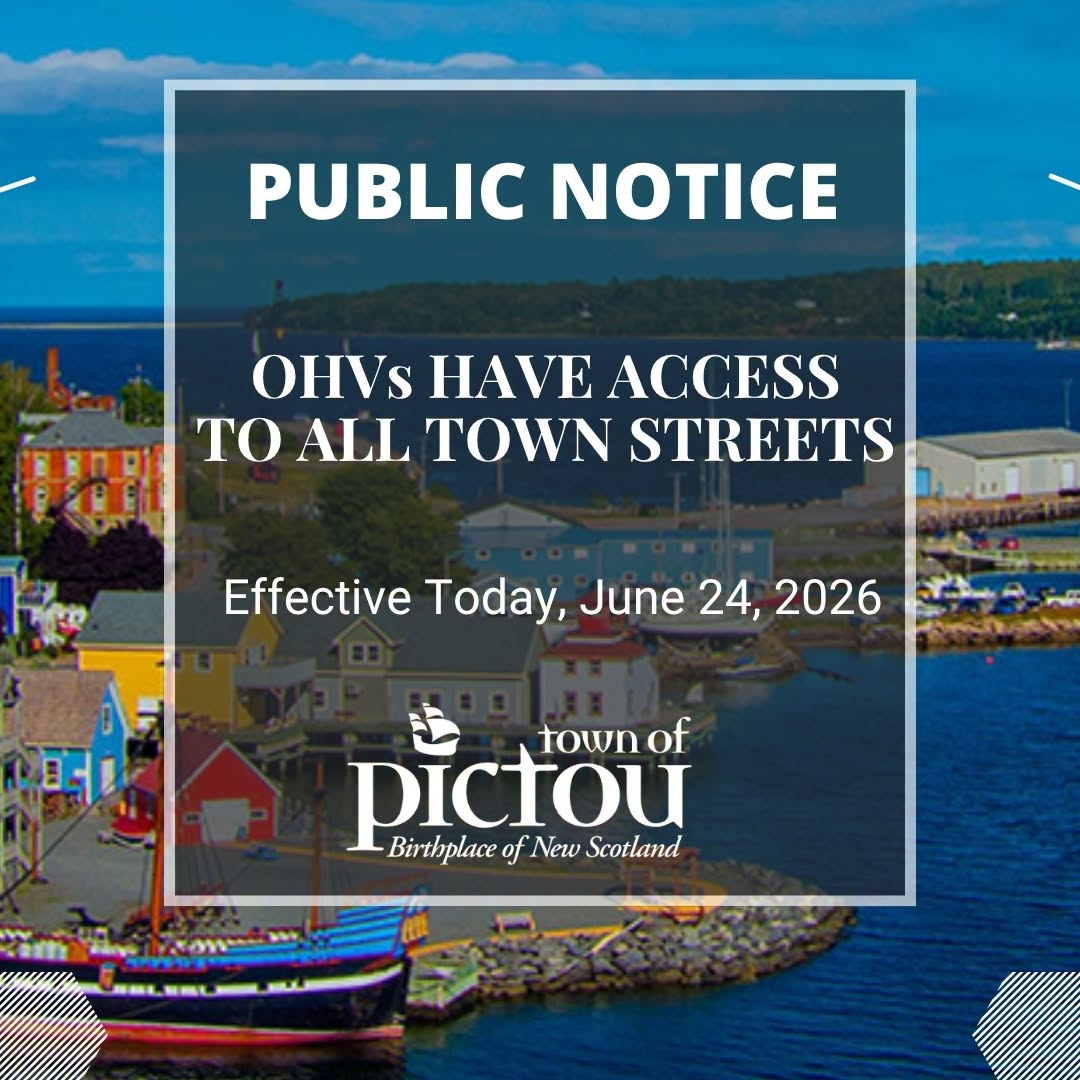
In the spring of 2023, the province passed Bill 273, the “Road Trails Act” which gives towns like the Town of Pictou the power to enact their own bylaws allowing OHVs, that meet requirements, to legally access designated roads. In April 2025 the Town of Pictou introduced amendments to the Town’s OHV By-Law to designate specific streets in the downtown and waterfront district open to OHVs which meet the requirements as set in Bill 273.
The following is a series of FAQs developed to answer questions about the bylaw, and OHV access to designated streets in the Town of Pictou.
DEFINITIONS:
OHV designates an “off-highway vehicle”, and also dirt bike, or other Off-Highway Vehicle that meet requirements (also known as “ATVs”)
“Road trail” means the shoulder and travelled portion of a highway designated under this Bylaw.
APPLICABLE LEGISLATION
BILL NO. 273, Road Trails Act, Province of Nova Scotia
Motor Vehicle Act
Off-Highway Vehicles Act
Town of Pictou Off-Highway Vehicles By-Law
PLEASE NOTE: Driver and passenger assume the risks of using a road trail. The Town of Pictou is not liable for injury, damage or death from operating on a road trail.
FREQUENTLY ASKED QUESTIONS
Q: On which streets in Pictou are OHVs allowed to travel?
A: At this time, OHVs are only allowed to access the following streets or portions of streets in Pictou (please refer to the Road Trail Map):
Brown’s Point Road, Weaver Road, West River Road, Haliburton Road, Church Street, Water Street, Front Street, Caladh Avenue, Market Street (from Water Street to Caladh Avenue), George Street, Coleraine Street, Commercial Street, Kempt Street, Creighton Street and Depot Street.
Q: Are designated streets accessible to all OHVs?
A: NOT NECESSARILY. A driver can operate an OHV, dirt bike, or other Off-Highway Vehicle on a Road Trail if they meet the requirements listed in Bill 273.
Q: What are the key requirements to operate an OHV on a designated street?
A: A rider must have a valid driver’s license (not learners) and third-party liability insurance. All riders must also have their OHV legally registered and inspected where applicable. License plates must be clearly visible, the same as on motor vehicles. Police can stop any OHV or motor vehicle to check for valid registration, insurance, and driver’s license.
Q: What are the key safety requirements?
A: Helmets and seatbelts* must be worn (*if OHV is equipped) and OHVs must have a headlight (on), red rear light, and left side mirror.
Q: Which system of signals to indicate turning or stop will be used?
A: Most OHVs are already equipped with brake lights and some brands even have signal lights. If not, riders must use their left hand with the arm to the left to indicate a left turn, the left hand pointing in the air for the right turn and the hand down pointing to the ground to indicate a stop or slowing down.
Q: What if I am in an accident while operating an OHV on a designated street?
A: If in an accident, stop, give information and provide assistance. If there is damage to an unattended vehicle, make an effort to identify the owner, and otherwise inform police. If a collision/damage occurs involving any OHVs and another OHV, or motor vehicle, it needs to be reported regardless of the amount of damage. Failure to do so, and if the rider(s) drives off, can result in a charge of failing to remain at the scene of an accident. The Registrar will receive and manage reports of accidents damages >$2000 or injury or death of a person.
Q: Are there any restrictions around children as passengers?
A: Yes, children under 9 years old are not permitted as passengers while accessing designated streets.
Q: Is there a speed limit set for OHVs using Water Street?
A: Yes, OHVs are not permitted to exceed 25 KPH while using designated streets.
Q: Is there a restriction on the noise made by OHVs?
A: Yes, noise may not exceed Original Manufacturer Specification.
Q: Are there any restrictions on the hours when OHVs can travel on designated streets?
A: Yes, no operation is permitted 30 minutes after sunset and 30 minutes before sunrise.
Q: Are OHVs permitted to go up any side streets?
A: No. Access is restricted to only designated streets.
Q: Where can OHV riders park?
A: There is designated street parking throughout the downtown and waterfront that may be used by OHV riders.
Q: Where can I get full details and information about the Provincial Road Trails Act?
A: The full act can be found on the Nova Scotia Legislature website at www.nslegislature.ca
Q: What else is important to remember when operating an OHV on designated streets?
A: Do not operate an OHV while impaired. Driving while impaired by drugs or alcohol on an OHV carries the exact same penalties as driving a motor vehicle under the influence of drugs or alcohol.
NOTE: if the above information referencing requirements is different from what is stated in the various Provincial Acts; then the Act prevails. It is the responsibility of OHV riders to consult the Acts and understand what is required while using an off highway vehicle on designated road trail.
Please ride safely!
Off Highway Vehicle - Designated Street Map, Town of Pictou
June 2025
pdf
Download Map pdf(2.03 MB)

Pictou Fisheries Pool YMCA
- Details
- Published: Wednesday, 30 July 2025 16:28
Fisheries Training Pool YMCA
We’re excited to share that the YMCA of Pictou County has taken over the operations at the Fisheries Training Pool. Moving forward, the facility will operate under new YMCA management. This marks a new chapter for the pool, as the YMCA brings its expertise in aquatic programming, community outreach, and health and wellness services to the space. The aim is to enhance your experience and offer high-quality programs for individuals of all ages and abilities.
For further information or schedule check out their website www.pcymca.ca/schedules/
For more information, please contact the Pictou Fisheries Training Pool YMCA at 902-600-2077 or check out their website YMCA of Pictou County
Town of Pictou Accessibility Plan
- Details
- Published: Wednesday, 23 July 2025 12:00
The Town of Pictou has updated its Accessibility Plan in collaboration with people with disabilities, their families, community organizations, and residents. The updated plan outlines actions to improve accessibility in Town programs, services, buildings, and public spaces, with a goal of meeting Nova Scotia’s 2030 accessibility target. pdf Click here to view plan(327 KB)